The Opening Frame
Early 2025. ServiceNow was making a significant bet on agentic AI, and the HR Service Delivery team had one question to answer before anything else: which use cases do we build first?
It sounds straightforward. It was not.
Enterprise HCM vendors were already building AI into their own modules. Customers were asking why they should buy from ServiceNow when their existing HR platform was shipping the same capabilities natively. That window was not going to stay open.
Trust was the other problem. Not technical skepticism. Something harder to fix. Customers had watched enterprise software overpromise before, and they were not ready to do it again without a clear answer on ROI. One customer asked it plainly: you can build this, but will they come?
Getting the prioritization wrong had a real cost. Build where HCM vendors already had strong AI and you lose on differentiation. Build for experience enhancement when customers want cost-saving automation and adoption stalls regardless of quality. Build without understanding where trust is fragile and even the right use cases land badly.
This is what was being decided before a single screen was designed.
Role and Co-ownership
This was a co-owned study. The research execution belonged to the UX research team.
My contribution sat in three places:
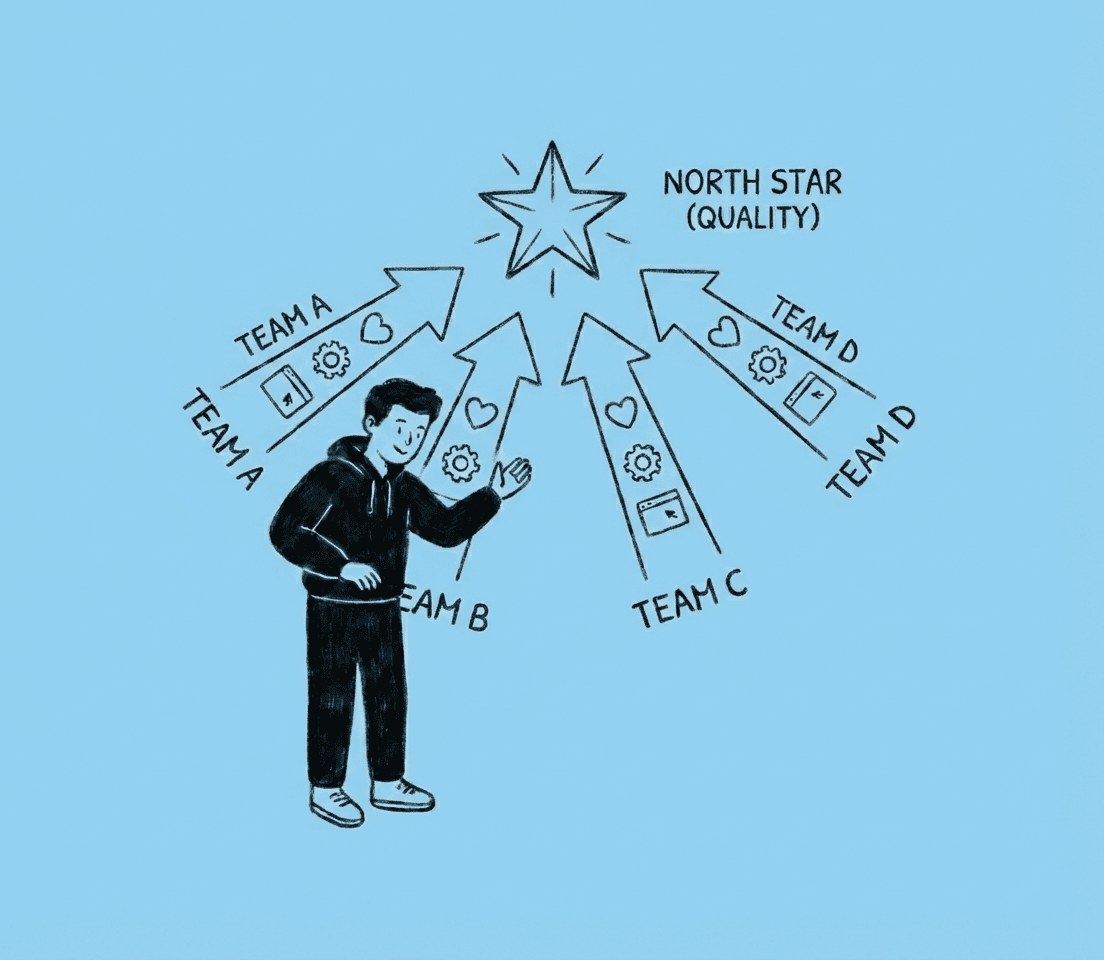
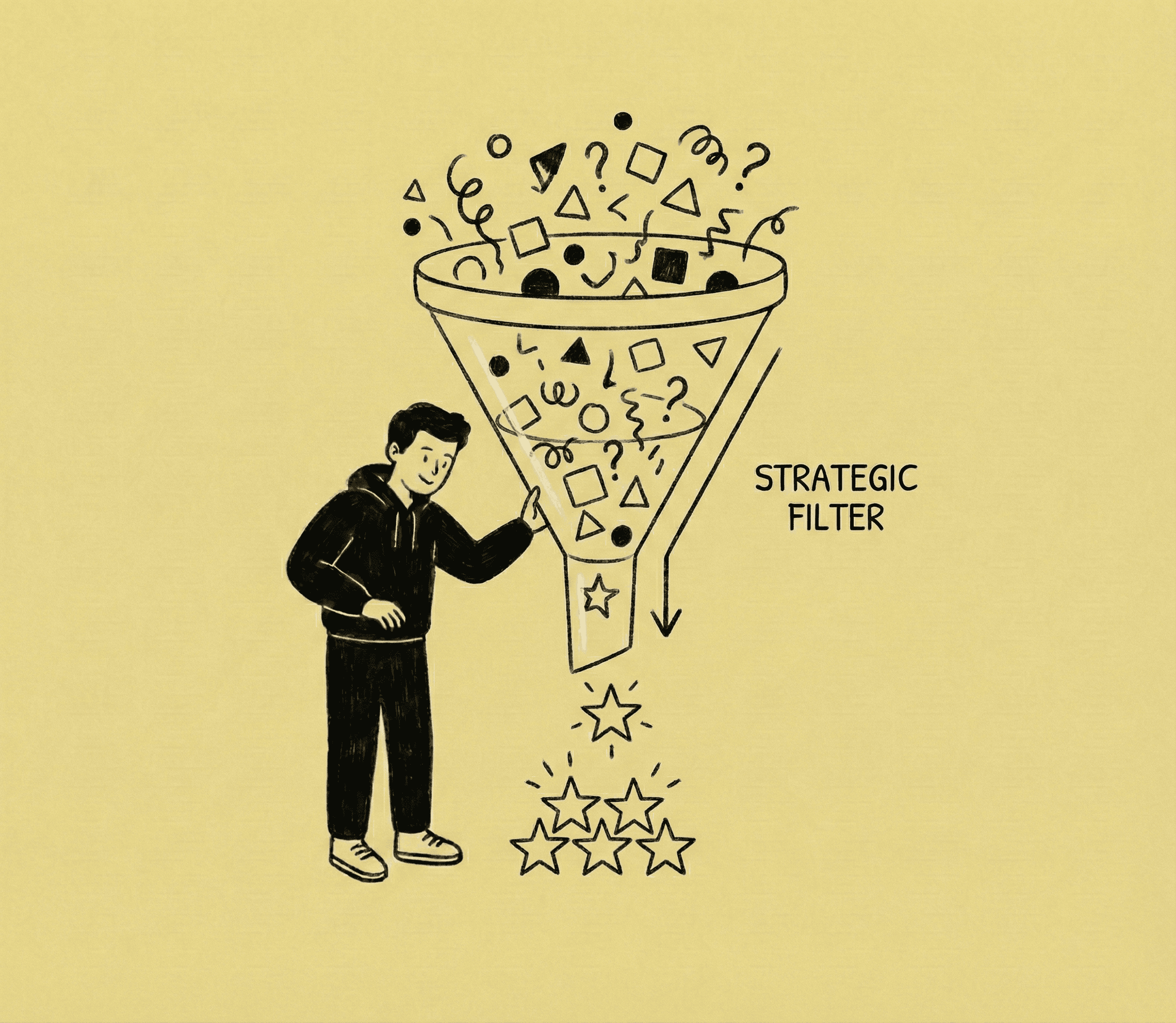
Co-designing the prioritization framework, the decision system used to pressure-test value and feasibility across twelve use cases and four persona groups
Owning the stakeholder narrative, translating research findings into a recommendation that landed with senior leadership up to CPO level
Leading the design execution that followed, Figma work across five use cases, some of which progressed into shipped features and one set presented at Knowledge 2025, ServiceNow's flagship customer conference
The Decision System
Before the study started, three use cases were already in motion. The assumption was that they were the right bets as senior enough problems, complex enough workflows, strategic enough for the HR business partner persona the team was trying to serve more deeply.
The study was designed to test that assumption. Not to validate it.
The design challenge
Enterprise HR leaders in early 2025 did not fully understand agentic AI. You could not ask them what they wanted and take the answer at face value. Stated preference would tell you what people could already imagine. The study had to get underneath stated preference. What do customers actually need, what is technically feasible, where do competitors already have ground, and where is trust too fragile to move fast.
Three streams, running in parallel
93 enterprise customers rated eleven defined use cases on a six-point scale ranging from Must Do to Don't Do, and in doing so, organically generated twenty more.
The internal stream covered 11 HR leaders across seven functions: service delivery, talent acquisition, talent development, employee relations, people analytics, people operations, and people strategy.
12 external participants were interviewed across three groups: HR business partners, managers, and employees, drawn from companies of varying sizes and industries.
The scoring framework
To make sense of what came back across three very different data streams, the team needed a consistent decision system. Something that would not collapse into gut feel when the data got complicated.
Each use case was scored across eight dimensions:
How saturated is the market with existing solutions?
How satisfied are customers with what already exists?
How repetitive and high-volume is the underlying task?
How frequently does it occur?
How critical is it to business continuity?
How senior or expensive is the person currently doing it manually?
Does this use case drive efficiency, or is it primarily experience enhancement?
Do customers actually expect to do this here, or do competing tools own the space?
Each dimension scored one to three. Maximum combined score across three persona groups was seventy-two.
What the data showed
What came back was not what anyone expected.
Agent Zero Auto Resolution topped the combined scoring at 64 out of 72. Offboarding scored 60. Onboarding Personalization 53. None of these were the use cases that had been in motion.
The customer demand signal was just as clear. 91% of surveyed enterprise customers rated Agent Zero as Must or Should Do. 79% said the same about Offboarding. The signal held across every research stream.
Customers were not looking for AI that made HR feel more personal. They wanted AI that cut the cost of running it.
"The effort felt too focused on experience over efficiency."
What they wanted was a zero-agent HR service center back office, AI handling the volume so humans did not have to.
The tension
Performance Management scored 61 out of 72. Every internal group rated it highly. HR business partners wanted it. People operations leaders called it a Must Do. The conviction was real. The problem it was solving is real.
But only 33% of enterprise customers said Must or Should Do. The second lowest score in the entire dataset.
That gap required a decision, not just an observation. Internal enthusiasm is a signal. It is not the same signal as customer demand. In a market where customers were already skeptical about ROI and actively comparing new AI capabilities against what their existing HR platforms were shipping natively, building first where customer pull was weakest was a risk the data did not support.
The recommendation was to follow the customer demand signal.
The shift
Before the study: three use cases already in motion, anchored around performance and talent strategy.
After: Agent Zero Auto Resolution, Offboarding, Onboarding Personalization.
Two of the original three carried additional flags beyond low customer demand. One was explicitly cautioned against on regulatory grounds by the talent acquisition team. The other scored at the bottom of the combined framework and landed in the Don't Do column for two internal groups, this was not because the problem was not real, but because the AI opportunity there was limited and the competitive overlap with existing HR platforms was high.
The new set shared three properties: strong customer pull, a clear platform fit that did not require customers to choose between new AI and tools they had already bought, and a value proposition built on cost and efficiency rather than experience.
That recommendation went to the product organization's extended senior leadership in April 2025.
Design Execution
Five use cases moved into design after the recommendation landed. Agent Zero Auto Resolution went first. It had the strongest customer demand signal and the clearest brief: reduce the cost of running HR operations by resolving routine employee inquiries without human triage.
The design work started with the agent team, not the interface. Five agents, each with a single job. One extracts case context. One checks criticality. One retrieves relevant knowledge. One updates the case record. One determines the right channel to close the loop. Designing those handoffs was the work before the work.
Routine inquiries resolved autonomously. Requests flagged for sensitivity routed to a human agent. The workflow made that separation visible and traceable.
The Growth Conversation Planner was a different kind of problem. Conversational scaffolding for managers running growth conversations with direct reports. The design question was how much structure was enough without tipping into something that felt scripted. This use case was later demoed publicly by ServiceNow's Chief Experience Officer at Knowledge 2025. Watch from 5:55 to 7:55.
The HRSD Agentic AI Vision Prototypes closed out the execution phase. Presented at Knowledge 2025 in a form the team had refined for the stage.
What This Changed
I came into this project thinking the hard question was which use cases were most valuable. It was not. The harder question was which ones organizations could actually trust enough to deploy.
That surprised me. Customers were not asking for smarter agents. They wanted predictable ones. Traceable, auditable, safe to run without someone watching. Use cases that sounded exciting in a demo lost momentum the moment data freshness or approval chains came up. The biggest adoption question was not model quality. It was whether the workflow lived somewhere employees already trusted, and whether it would behave the same way twice.
If I ran this again I would push for a small concept validation sprint earlier, before the full readout, to test the prioritization hypotheses against something real. I would also bring legal and IT admin in from the start rather than routing their input through late-stage review.
What it changed: I now treat AI initiatives as workflow design problems before anything else. Where does the handoff happen? What is auditable? What can a user correct? Those questions used to come up later. Now they are how I start.