Project overview
Role: Senior Product Designer, IC, high ownership
Partners: Staff UX Researcher, Principal PM
Scope: 15 customer companies / 28 interviewees / 1,200 minutes of interviews
Year: 2020-2021
Most organizations can collect employee feedback. Almost none of them can close the loop on it.
Employees fill out surveys. HR teams run the analysis. Leaders review the charts. And then the feedback quietly disappears into a process that was never designed to act on it. People stop participating. Leaders stop believing. Listening becomes a ritual that signals care without actually delivering it.
This discovery was built to find out why.
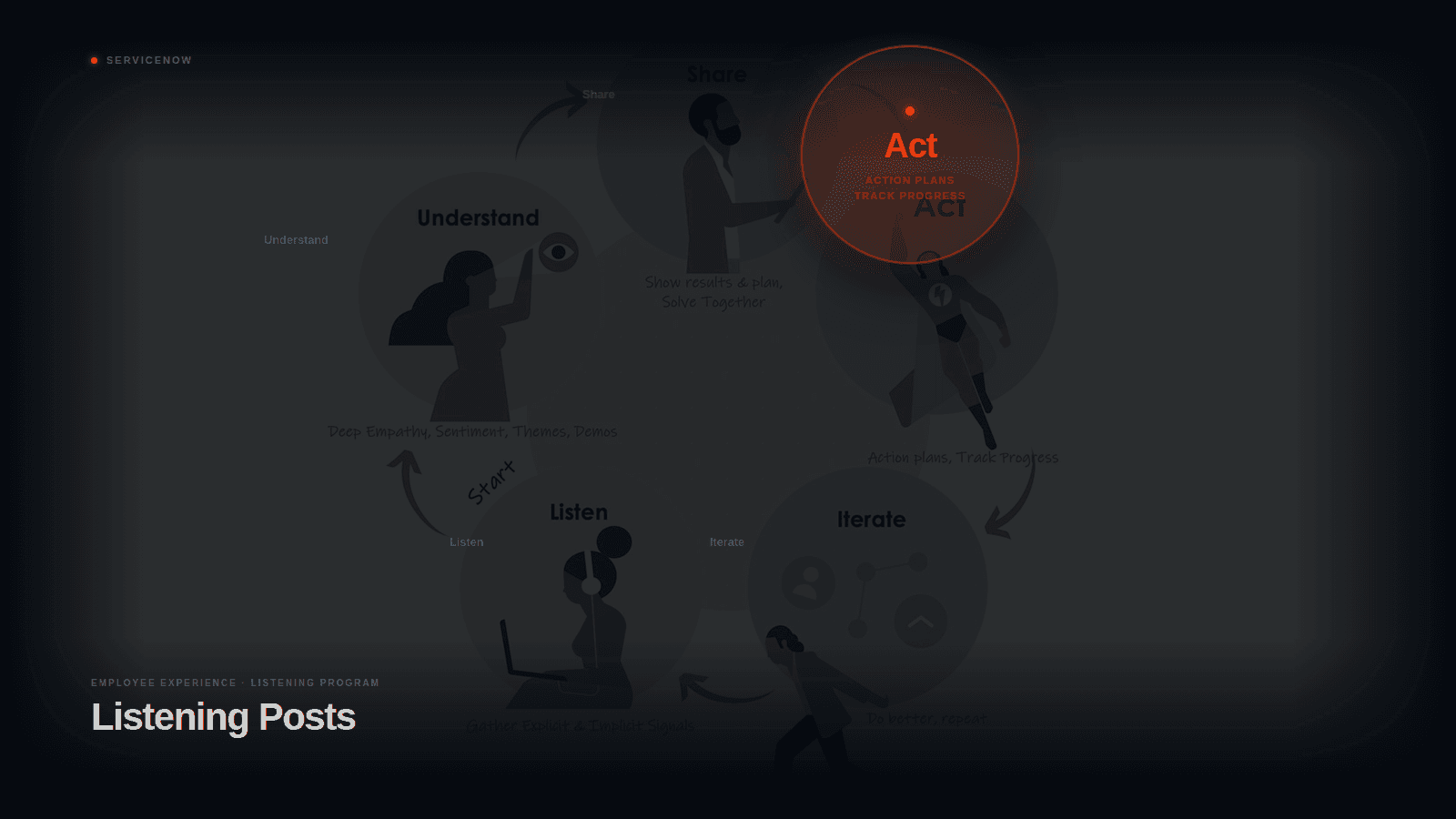
What we found was that the failure was not in the listening. It was in everything that came after. The direction that came out of this work was a complete closed-loop model, Listen to Understand to Share to Act to Iterate, that made follow-through a product responsibility rather than a process hope.
Artifact: Signals to action model
Signals (direct + indirect + behaviors) → Themes → Close-the-loop cycle (Listen → Understand → Share → Act → Iterate)
(Visual to be added)
Context
When I joined ServiceNow as a Design Lead, Listening Posts was the first space I truly owned. It was exciting, but also intense. Employee Experience was becoming a serious investment area, and I needed to ramp fast, earn trust, and bring clarity in a domain full of opinions.
At first glance, Listening Posts looked like a familiar problem: surveys, questions, dashboards.
Then we started talking to customers.
Again and again, we heard a version of the same line:
“We ask employees for feedback. We analyze it. And then… nothing really happens.”
That “nothing” is where trust breaks. People stop participating, leaders stop believing the program works, and listening becomes performative.
Design question
How might we help People Orgs listen in time, understand the signal, and close the loop with credible communication and action?
What we proved in discovery
The discovery wasn’t about what people prefer. It was about constraints that show up in real organizations.
Privacy is global, but must be configured locally: anonymized aggregation plus controlled segmentation
Frontline access is a real constraint: not everyone has a desk or email, listening must meet employees where they work
Closing the loop is the trust hinge: communication and follow-through determines whether employees keep engaging
Action and accountability are the hardest part: teams struggle to translate insights into accountable actions, often tracking work offline
What stood out to me was the gap between intention and reality. People Orgs genuinely wanted to do right by employees. They just didn’t have a system that made follow-through easy.
Turning point 1: The day “survey-first” stopped making sense
Early on, the gravitational pull was obvious: make the survey experience better. Better templates. Better questions. Better analytics.
But a pattern kept showing up in interviews that broke this framing.
Frontline employees were often unreachable by default channels. Many did not have desks or email. Even when they did, surveys felt detached from work. It was like asking someone to reflect on their day from a distance, after the moment had passed.
That’s when the direction changed.
Instead of treating Listening Posts as surveys, we treated it as signals in the flow of work.
What this unlocked
A clear product direction: multi-channel delivery that fits where work happens (mobile, SMS, web, virtual agent style touchpoints), not just where HR prefers to run programs.
Turning point 2: The real failure wasn’t insight. It was follow-through.
The second shift was even more important.
Most teams we spoke to could collect feedback. Many could analyze it too. The breakdown happened after the chart.
What employees wanted was simple:
“Did you hear me, and what will you do about it?”
What People Orgs struggled with was also simple, but harder:
“How do I turn this into actions that are owned, tracked, and communicated back without creating a manual mess?”
That’s when we stopped treating follow-through as a “process problem” and started treating it as a product problem.
We made the missing steps explicit: Share and Iterate.
My role and key moves
My focus was to move the team from raw signal to a buildable direction, owning the synthesis layer end to end.
What I drove:
Built the synthesis template from scratch that consolidated interview signals across all 15 companies
Ran the working session where the team converged on the three bets taken forward
Authored the close-the-loop framing, Listen to Understand to Share to Act to Iterate, which was adopted largely as written in the final readout
Framed the problem as a system rather than a feature set, which became the foundation for how the team aligned on scope
The research and PM partners were essential. The connective tissue, turning what we heard into something a product team could build toward, was mine to own.
A moment that changed the direction
Early in the project I felt the reporting experience was not going to scale. It handled the immediate brief but the foundation was not built for where the product needed to go. Question type flexibility, the right data representations, filtering, and privacy built into the reporting layer itself rather than bolted on. I could see the gaps but instead of flagging them in a meeting I spent a weekend rebuilding the concept from the ground up.
When I brought it into the room nobody debated it. The team just moved toward it. That was the moment I understood that sometimes the most effective way to change a direction is to show a better one rather than argue for it.
Decisions this research influenced
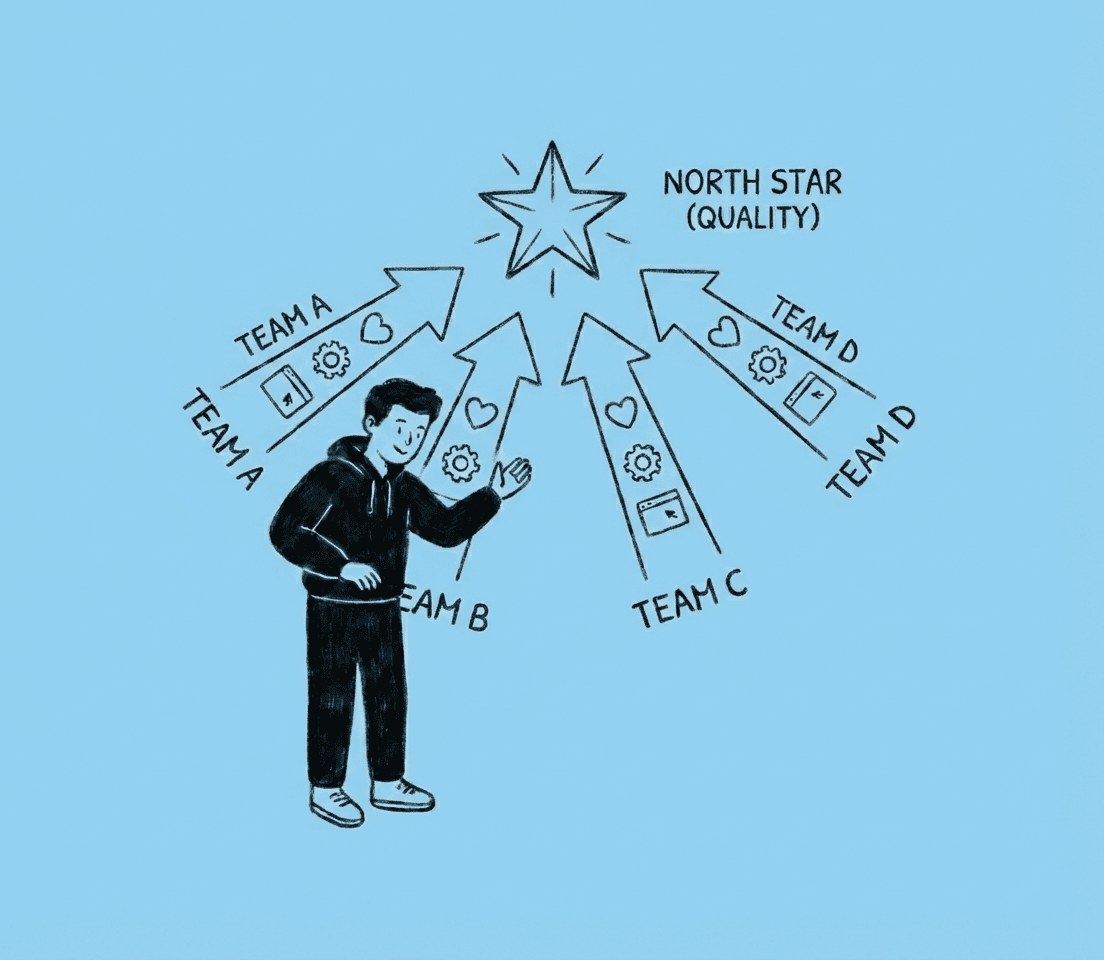
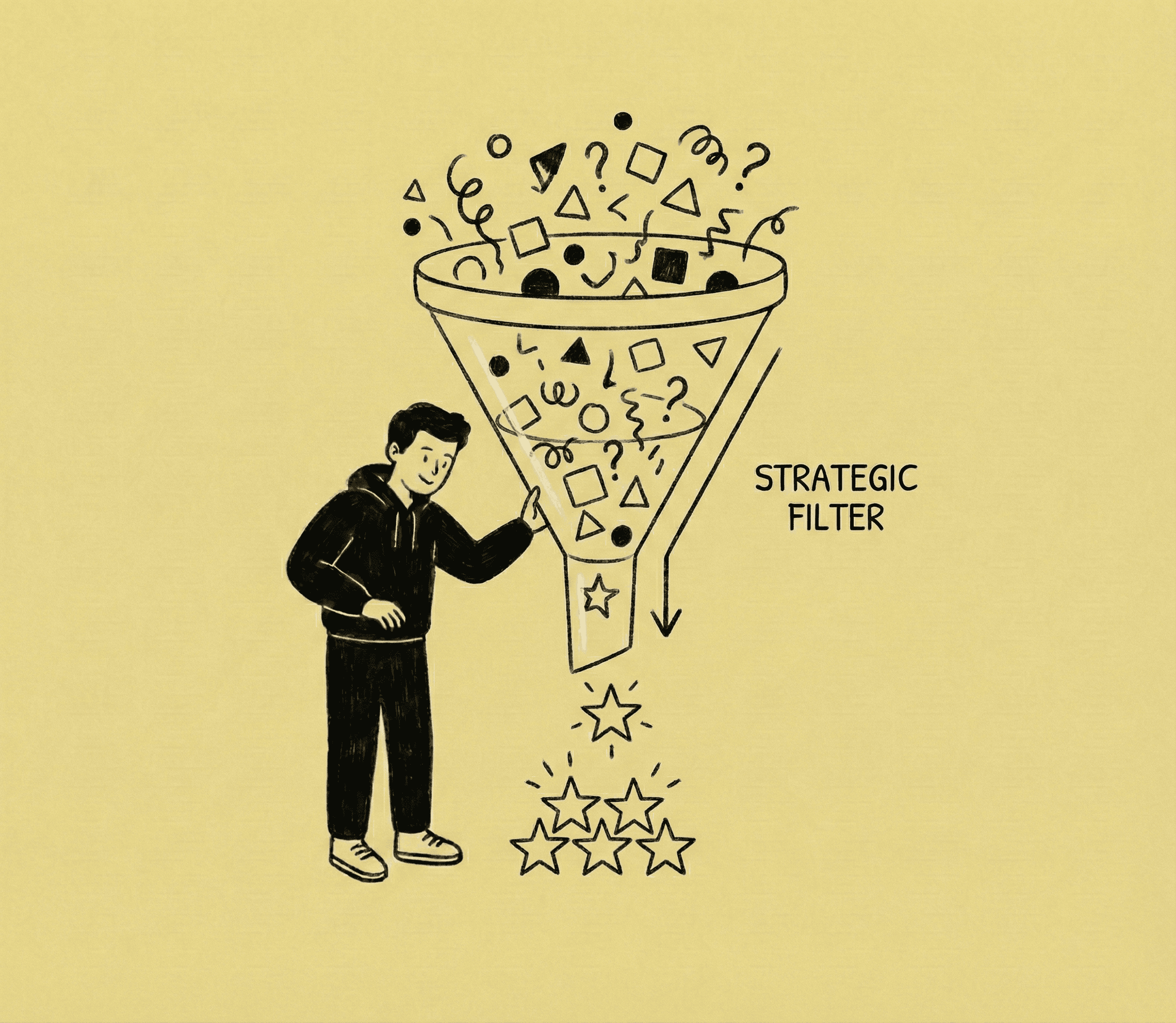
This discovery directly shaped what we prioritized for concept validation and direction:
In-the-flow delivery channels for surveys
Pulse surveys delivered in the context of work across mobile, SMS, web, and virtual agent style touchpoints.Action planning workflows
Action planning as a first-class workflow so teams can translate insights into accountable follow-through, not spreadsheets and slide decks.Privacy assurance as a repeatable UX moment
Privacy reassurance made explicit at the moment of feedback capture, reflecting the global yet local privacy requirement.
Artifact: What we took forward
Three tiles representing the key decisions carried into product direction.
(Visual to be added)
Outcomes
This discovery did not just produce insights. It produced direction.
We left discovery with three buildable bets to validate next
We aligned the team around a complete closed-loop model, making Share and Iterate non-negotiable
We created a shared language (signals + moments that matter) that reduced repeated debates and improved clarity across stakeholders
What we deprioritized
Not everything that surfaced in discovery was ready to build toward. Three directions had real potential but were consciously parked.
Passive listening signals Help desk cases, employee relations issues, 360 feedback, performance reviews, turnover rates, call and chat transcripts. All high-value signal. But active listening infrastructure had to come first. The sequence mattered.
Observable behavior signals Recognition patterns, meeting attendance, PTO behavior, benefit opt-ins. The signal was interesting but the privacy and ethics complexity was not something we had enough clarity or customer appetite to navigate at this stage.
Real-time proactive nudges Empowering managers with real-time sentiment and personalized follow-up nudges. Compelling direction, but a known unknown for us. Too early, too investment-heavy, and too dependent on active listening infrastructure that did not exist yet.
External validation
Listening Posts later appeared in external coverage as part of ServiceNow's broader Employee Journey Management narrative.
ERP Today calls out Listening Posts as a capability to create short or long form surveys integrated into employee journeys.
HR Executive recognized ServiceNow Employee Journey Management as a Top HR Product for 2021, highlighting in-moment employee feedback and personalized action plans.
The direction this discovery shaped is what became Employee Journey Management.
I was one designer on a broader product effort, and this external coverage validates the market direction the team invested in and that this discovery helped shape.
Looking back
Discovery work at this scale rarely ends cleanly. We left with direction, not certainty, and that was the right call. Trying to validate everything before moving would have cost us the momentum that made the bets land.
If I were doing this again I would push earlier to make the employee voice more present in the readout. The People Org perspective dominated, understandably, but the employee side of the loop deserved more weight in how we framed the direction to stakeholders.